

Install the FLEXXCEL HT belt material on the expansion joint frames per the BELT INSTALLATION INSTRUCTIONS. Leave section on top of duct “unbolted” at preferred splice area. Carefully trim FLEXXCEL HT belt material so the two ends “butt up” with each other.
Cut PFA film and 3″ wide FLEXXCEL material strip to equal the width of the installed belt. Staple the PFA film to the “gas side” of the FLEXXCEL material strip.
Slide the backer board under the splice area. Place the FLEXXCEL material strip over the “trimmed” HT material with the PFA film facing down. Place iron at edge of belt to begin splice. Apply pressure to iron handles during each splice. Each splice section should take approximately 5 minutes.
U.S. Bellows manufactures high-performance fabric expansion joints for industrial applications. These expansion joints often require thermal-welding (heat seal splice) in field service. Cost effective and easy-to-use heat seal irons are available from U.S. Bellows for use with FLEXXCEL materials.
The main function of a heat seal iron is to introduce enough heat to allow a proper bond between PTFE surfaces of FLEXXCEL materials. The melting point of PTFE is around 621°F (327°C). However, the setting of a heat seal iron is determined by factors like ambient temperature, thickness of bonding materials, and the surface upon which you heat seal. Applying pressure can help facilitate a good bond, but in order to achieve a correct bond, the melting point of the U.S. Bellows FLEXXCEL materials must be achieved.
Using the U.S. Bellows drawing, organize the parts per drawing information and “match markings” on parts.
Clean duct/flange surfaces and prepare for welding.
Tack weld frame segments into place. If the expansion joint has a liner, make certain that the flow arrow of the expansion joint/liner is in the proper system flow direction. If liner ships loose, install frames first to allow seal weld access.
Seal weld frames.
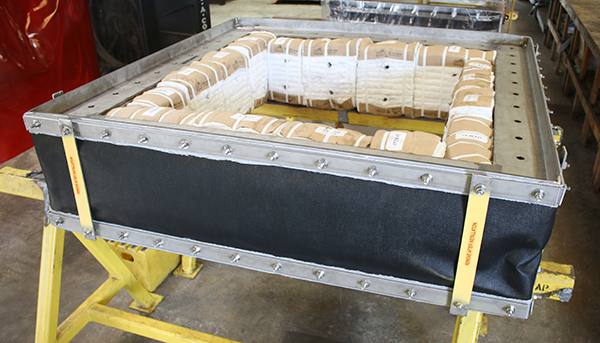
Install accumulation barrier/insulation pillow — if required.
Accumulation Barriers are typically designed to fill the entire cavity of the expansion joint. Wrap the accumulation barrier around the duct/expansion joint. Pack the accumulation barrier into the cavity of the expansion joint. The liner will prevent the barrier from falling into the duct. Use thread or wire to tie across the breach opening to support accumulation barrier during installation. Remove thread or wire prior to installing the fabric belt element. Insulation pillows are typically designed to prevent high temperatures from contacting the fabric belt material; therefore it is critical to attach the pillow in place. There are multiple ways to attach the pillow. Follow U.S. Bellows drawing for details. Pinning the pillow to the liner (as shown) or the frame are common methods of attachment.
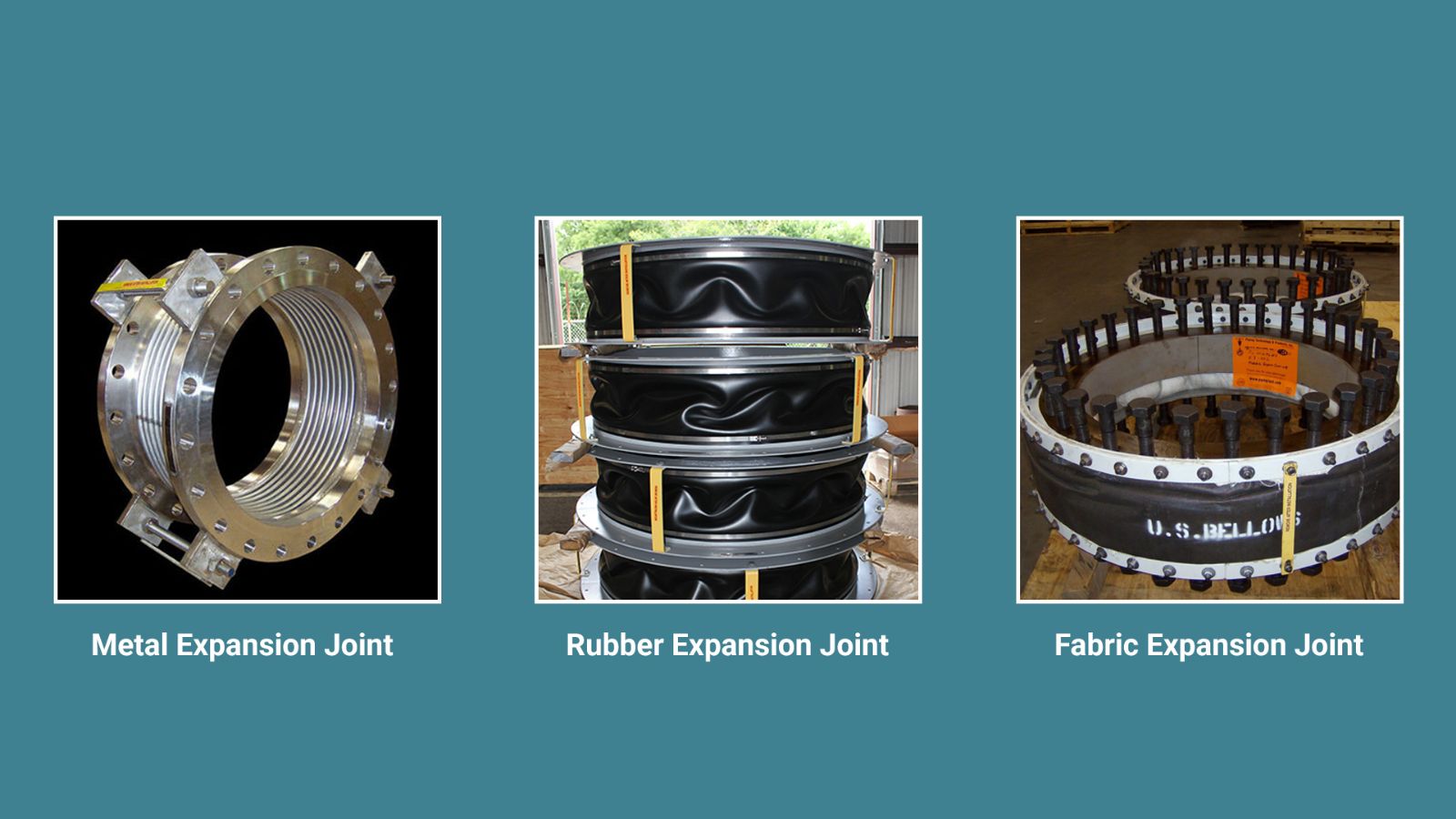
Fabric expansion joints can be shipped in a variety of conditions to allow for the most economical installation. In certain instances, it is practical to ship joints fully assembled ready to drop into place. In other cases where access is limited or joint size exceeds normal shipping constraints, the joint can be broken down into small segments and then assembled in place at the job site.
U.S. Bellows will provide the appropriate detailed storage, handling, and installation instruction based on how the expansion joint is shipped.Please use these instructions for assembled fabric expansion joints in conjunction with the approved drawing provided by U.S. Bellows.
Pre-Installation Check-list:
Confirm dimensional data per U.S. Bellows’ approved drawing.
Confirm duct/duct flanges are in good condition.
Confirm duct/duct flanges are lined up correctly (ensure that lateral displacement and angular movement do not exceed agreed specifications)
Prior to installing the expansion joint frames, the opening into which the expansion joint will be installed must be inspected to verify that the opening is in accordance with design tolerances. The expansion joint is not designed to accommodate installation misalignment, unless clearly specified as a design requirement.
Make available the following tools/equipment to simplify the installation:- Suitable/safe scaffolding
- Lifting equipment (fork lift, crane, hoist)
- Drill
- Come along
- Rope
- Pry Bar
1. Compare the maximum continuous operating temperature of the application against the fabric temperature rating.
2. If the application has high fly ash or dust loading, select a material with high tensile strength.
3. If the application is near a fan or where flow turbulence is expected, select a material with high flutter resistance.
4. Elastomers vary in their chemical resistance. The selected Elastomer should be checked to insure that it is compatible with the particular media it will encounter.
Material Name
Elastomer
Temp. (F)
Service
Tensile Strength
Flutter Resistance
FLEXXCEL RH125
Hypalon
225
Dry
Medium
Medium
FLEXXCEL RE125
EPDM
300
Wet*
Medium
Medium
FLEXXCEL RE25
EPDM
300
Wet*
High
High
FLEXXCEL RC125
Chlorobutyl
300
Dry
Medium
Medium
FLEXXCEL RC25
Chlorobutyl
300
Dry
High
High
FLEXXCEL RVF25
Fluoroelastomer
400
Wet
Medium
Medium
FLEXXCEL RVF25
Fluoroelastomer
400
Wet
High
High
FLEXXCEL RVF25M
Fluoroelastomer
400
Wet
High
High
* Not suitable for sustained service where oils, hydrocarbons or concentrated minerals acids are present.
Elastomers— A general name for the group of synthetic “rubber” materials that are characterized by their elastic property. These materials are also known by their commercial names as Viton®, Hypalon®, EPDM, and Chlorobutyl.
Before the development of Fluoroplastics, a group of synthetic “rubber” materials were commonly used in flue duct expansion joint applications. These materials, known as Elastomers, include Viton™, EPDM, Chlorobutyl, Hypalon™ and others.
Because of their elastic properties, the various Elastomers are built up into a multi-layered sheet reinforced with fiberglass or Aramid fabric. The finished product, 1/8″ to 1/4″ thick, is then used as a flat belt or as an integrally flanged U-shaped cross section that bolts directly to duct or equipment flanges. The inherent characteristics of flexibility, abrasion resistance, and flutter resistance translates to long service life when applied properly.
Fabric expansion joints consist of two major components, the fabric belt material and the metal frame. The frame can connect to the ducting by welding or bolting. Each U.S. Bellows frame style has features designed to minimize the detrimental effects of temperature, movements, pressure, media, and turbulence. The U.S. Bellows team is experienced in evaluating application conditions and implementing designs that lead to long term expansion joint service.
Design alterations can include the following:
Adequate stand off height
Adequate face to face dimension
Inclusion of liner
Frame material
Belt material
Inclusion of accumulation barrier
Inclusion of insulation pillow
Proper bolt hole spacing
And more
Although U.S. Bellows can provide weld-in and bolt-in frame styles, wherever possible, it is strongly recommended that the expansion joint be welded in place.
Weld in design frame styles allow the expansion joint to weld directly to the duct or duct flanges. These frames styles are basic designs that can be augmented with optional components.
Benefits of weld in designs include:
Weld in designs are less expensive to manufacture.
Accurate field bolt hole dimensional data can be difficult to obtain and verify.
Welded connections can accommodate “real world” field conditions and inaccuracies that occur during installation.
Bolt in design frame styles allow the expansion joint to bolt directly to duct flanges or equipment flanges supplied by others. These bolt in designs are generally more expensive to manufacture and are potentially more difficult to install due to hole pattern irregularities and inaccuracies. These frame styles are basic designs that can be enhanced with the optional components.
Similar Applications: Fossil Fired Power Plant (Gas Recirculation System), Pulp and Paper Plant (Recovery Boiler to Precipitator), Refinery (Turbo-Expander to CO Boiler and CO Boiler to Precipitator), Cement Plan (Clinker Cooler to Heat Exchanger)
Typical Conditions: 650°F to 850° operating temperature, -10″ to -25″ WG pressure, fuel gas media with heavy particulate, boiler growth contributes to large axial or lateral expansion joint movements depending on the orientation of the joints
Similar Applications: Fossil Fired Power Plant (Air Heater to Coal Pulverizers), Cement (Clinker Cooler to Heat Exchanger)
Typical Conditions: 600°F to 750°F operating temperature, 5″ to 80″ WG pressure, clean air media, boiler growth contributes to large axial or lateral expansion joint movements depending on the orientation of the joints.
Common Design Features:
Fabric Belt: High temperature fabric belt. (FLEXXCEL HT1, HT3, or HT5 depending on maximum temperature.)
Accumulation barrier: 6″ minimum standoff and outboard belt attachment flanges to dissipate heat.
Liner: contoured around expansion joint to allow heat dissipation.
Similar Applications: Cement Plant (Preheat Tower), Refinery (CO Boiler to Precipitator)
Typical Conditions: 250°F to 500°F operating temperature, -35″ to -50″ WG pressure, flue gas with possibly fly ash carryover through air heater, moderate thermal movements in ducting.
Similar Applications: Fossil Fired Power Plant (Re-heater to Chimney), Pulp and Paper Plant (Induced Draft Fan to Chimney), Refinery (Steam Generator to Stack)
Typical Conditions: 250°F to 500°F operating temperature, -35″ to +50″ WG pressure, minimal particulate downstream of precipitator, potential for wet conditions.
Common Design Features:
Fabric Belt: At fan locations, the belt material should have a high resistance to flutter. (FLEXXCEL FF1)
Accumulation barrier: Bolt-in design for attachment to equipment or duct flanges. (If equipment or duct flanges are not present, weld in designs are recommended.)
Liner: Flow liner to reduce turbulence/flutter of fabric belt material.
Similar Applications: Fossil Fired Power Plant (Scrubber Bypass to Stack and Scrubber to Re-heater), Pulp and Paper Plant (Scrubber Inlet and Scrubber to Re-heater)
Typical Conditions: 120°F to 350°F operating temperature, +5″ to +15″ WG pressure, minimal particulate, highly corrosive wet gas, minimal movements.
Common Design Features:
Fabric Belt: Fabric material should have the maximum chemical barrier due to corrosive conditions. (FLEXXCEL HC40)
Recommended Expansion Joint Designs: Style 100W, 300W, 100B, and 500B
The reduction in the breach opening along the axis of the duct. This is usually a result of thermal expansion of the ducting.
Axial Extension
The increase in the breach opening along the axis of the duct. In certain configurations, the duct thermal expansion may result in extension at the expansion joint location.
Lateral Movement
The relative movement of the upstream and downstream faces in the direction perpendicular to the axis of the duct.
Torsional Rotation
The twisting of one side of the duct about the longitudinal axis.
Angular Rotation
The twisting of one side of the duct about an axis perpendicular to the longitudinal axis.
View our online fabric catalog for more information on fabric expansion joint movement
Fabric Expansion Joints and Factors Influencing their Design
Fabric expansion joints perform a function of compensating for duct misalignment and duct thermal growth typical in power plants and other ducting systems. Proper design of these joints starts with asking the right questions about the application, providing the correct answers, and applying design rules to arrive at the appropriate solution.
The guiding principle for fabric joint design is to protect the fabric belt element so that it can absorb movement while retaining the media. The longevity of the belt life can be diminished by many factors. These factors include excessive temperature, harsh corrosives, exposure to abrasive particulate, excessive movements, fly ash weight against the belt, and high internal pressures. All of these problems can be solved if they are anticipated. The quality of the expansion joint design is only as good as the information provided up front. A realistic and accurate analysis of the system is step one. Assuming that is taken care of, these guidelines are a brief introduction to factors that influences the success of the expansion joint.
Temperature
Fabric gas seal membranes have specific temperature capabilities. When necessary, the addition of insulating materials between the temperature source and the belt will extend the service life. The magnitude of the temperature will determine the thickness of the integral belt insulation and if a separate high density insulation pillow is required.
The belt attachment flanges should be outboard of the cavity and have sufficient standoff from the duct. Care should be taken to avoid external insulation or lagging outside of the belt which prevents proper heat dissipation.
Chemical Attack
Applications that do not have high temperatures sometimes have a different problem. Relatively low temperatures in flue gas ducting can lead to corrosive condensation. In these situations, a chemical barrier is required to protect the load bearing fiberglass carcass of the belt. External insulation over the joint in these locations can reduce condensation and heat loss.
Movements
Generally, movements occur along the axis of the duct (usually compression but occasionally extension) or at right angles (lateral). The key to being able to handle these movements is having the proper width of belt installed in a sufficient span. For compression, a ratio of installed belt span to movement roughly at 4:1 is suggested. The lateral capability is influenced by the amount of belt slack available. Concurrent axial compression will provide the slack thus allowing more lateral. In certain situations, there is lateral offset in the cold installed condition. This may require “pre-compression” of the joint which is in essence just providing extra belt width.
Abrasion
In flue gas ducting with particulate, a liner should be used to protect the belt from direct exposure. If the pressure is negative, the belt stand-off from the gas stream should be increased to keep the belt from being pulled into the gas stream or against the liner. Belt clamping bar edges next to the fabric should be radiused. The belt attachment flange should also be smooth and free of rough surfaces.
Pressure Fluctuations
Fabric expansion joints exposed to sudden pressure fluctuations, such as near ID fans and dampers, may result in the belt “fluttering”. The fabric will fatigue over time resulting in tears. Using stiffer fabric material, installing a liner and increasing the standoff are steps to take to avoid flutter.
Summation
Each location throughout a ducting system can have different conditions that affect the design of expansion joints. As a result, there isn’t one design that can fit all applications. The goal of the expansion joint supplier is to work with engineers and end users to provide the optimum economical solutions.