

|
Bellows can be formed from most ductile materials that can be welded by the automatic T.I.G. welding process and result in a homogenous weld structure. It is imperative that companies specifying and purchasing bellows give thorough consideration to the selection of the bellows material. Due to the fact that a given media will vary from system to system, and that most media specifications cannot accurately reflect what actually will occur during system operation, it is not appropriate for Piping Technology to make specific recommendations regarding bellows material. If any doubt exists concerning proper material selection for the bellows, we recommend that a metallurgist with the appropriate basic material supplier be consulted. CATALOG BELLOWS MATERIALS |
|
Material Type |
ASTM* Material Specification |
 |
|
|
304 S/S |
A-240 |
||
|
304L S/S** |
A-240 |
||
|
316 S/S |
A-240 |
||
|
316 L S/S |
A-240 |
||
|
321 S/S |
A-240 |
||
|
Monel 400** |
B-127 |
||
|
Inconel 600 |
B-168 |
||
|
<Inconel 625 |
B-443 |
||
|
Incoloy 800/800H** |
B-409 |
||
|
Incoloy 825** |
B-424 |
||
|
Hastelloy C-276** |
B-575 |
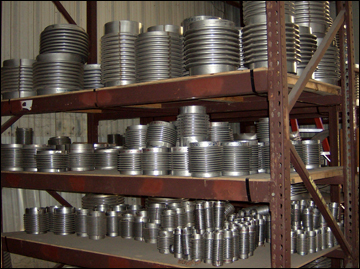
PT&P’s Stock Bellows
|
|
| ** ASME “SA” or “SB” materials are inventoried in limited gauges.
All bellows material purchased by Piping Technology is in “mill annealed” condition, in accordance with “A” or “B” specifications (“SA” or “SB” for ASME Code requirements). Any other heat treating operations before or after welding, and before or after forming the bellows convolutions will not be performed unless specified by the purchaser. It should be noted that heat treating the bellows after forming the bellows convolutions alters the bellows capabilities and performance characteristics, namely pressure capacity, spring rate, and cycle life. We will cooperate with our customers that specify post-form heat treatment of the bellows to determine the effects that the heat treatment will have on published bellows performance data. |
||||||||||||||||
| COMMON BELLOWS MATERIAL FAILURES | ||||||||||||||||
|
||||||||||||||||
|
(1) It is important to note that nickel alloys are typically specified per steam service to avoid chloride-induced stress corrosion. The steam must also be checked to avoid nickel alloy failures in steam lines which contain caustics. |
||||||||||||||||