


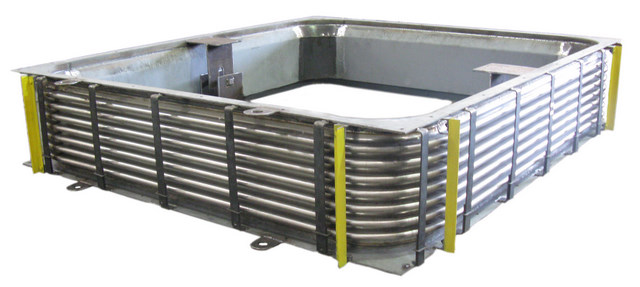
|

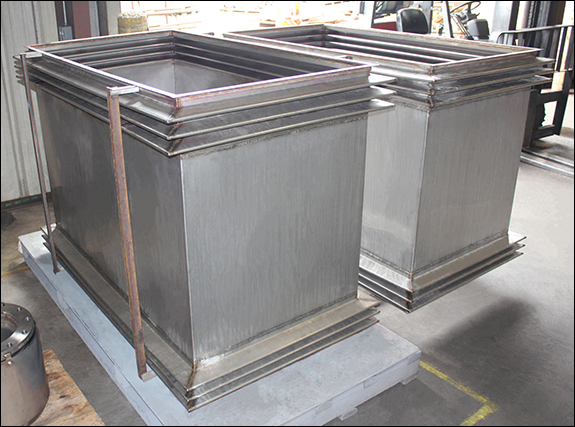
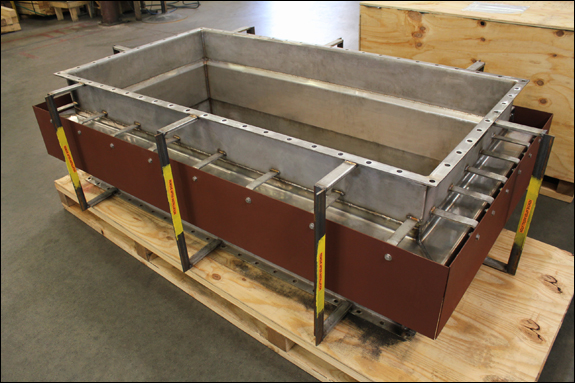
Like circular expansion joints, rectangular expansion joints absorb three types of movement: axial, lateral and angular. For the purpose of designing rectangular bellows, it is critical to know in which direction the lateral and angular movements will occur, i.e. parallel to the long and/or short side of the bellows. It is important to understand, however, that due to the large sizes that rectangular expansion joints frequently are, lateral deflection of single bellows is often impossible. The proper design for a rectangular bellows for these types of movement is a universal expansion joint, in which two bellows elements connected with a center duct section (centerspool) are used in tandem. Due to the relatively long overall lengths and high costs associated with universal rectangular metal designs, it is recommended that PT&P's non-metallic expansion joints be considered for applications involving lateral movements, and also those that might possibly involve torsional movements.
Unlike circular bellows where the pressure stress is a circumferential membrane (hoop) stress, the rectangular bellows must be designed for longitudinal (beam) bending stresses. Long unsupported lengths must frequently be supported to prevent excessive deflection and stresses of the bellows element. In certain applications, covers and liners can perform the function of pressure supports.

General arrangement of rectangular expansion joints with supported sides. |
PT&P designs rectangular metallic expansion joints in accordance with the criteria published in Section C-8 of the Standards of the Expansion Joints Manufacturers Association. PT&P strongly encourages that customer to become familiar with the Standards of the Expansion Joints Manufacturers Association when specifying and purchasing all metallic expansion joints, and require them to be designed and fabricated in full accordance with those standards.
Typical convolution geometry's and corner construction details are shown on this page. The "V" convolution profile will be supplied with single miter corners, unless otherwise specified. Round corner bellows will always be constructed using the "U" convolution profile.

Single Miter Corner
Rounded Corner

Camera Corner

"V" Profile

"U" Profile |