


Bellows Expansion Joint: Pressure Loads, Anchors & Guides
- Tension & Compression System
- Bellows “PA” Load
- Bellows Effective Thrust Area
- Main Anchor Design
- Intermediate Anchors, Pipe Guides and Pipe Buckling
- Pipe Tension Systems
Appendix
Intermediate Anchors & Pipe Guides and Pipe Buckling
Pipe systems containing bellows and external main anchors (compression system) must be guided by full lateral restraint type guides. No more than one bellows should be used between any two anchors. Hence if more than one bellows is required, the piping system should be divided up into sections, containing one bellows each, by intermediate anchors. Intermediate anchors do not carry pressure thrust load, but must be designed for bellows deflection forces and frictional forces from supports and guides. See “Tension & Compression System” for more information on this subject.
There are several important reasons for the requirement for guides:
1. Direct motion into the bellows.
2. Stabilize the ends of the bellows against “squirm.”
3. Prevent buckling of the pipe due to pressurized fluid column effect.
4. Weight support.
Rules for guiding of pipe containing bellows are given in “Tension & Compression System.”
Buckling of pipe due to the compression effects of a pressurized fluid column is not a widely understood phenomenon. In a tension system, where normal longitudinal tensile load is maintained, this cannot happen, no matter how long the un-supported (or guided) length of pipe. However, in a compression system a column buckling effect can occur, even when there is no externally generated longitudinal compression load on the pipe. Normally, with a bellows there is a longitudinal compression in the pressurized pipe due to bellows sidewall load. However it is the full bellows thrust area which determines the buckling pressure.
Consider the following arrangement:
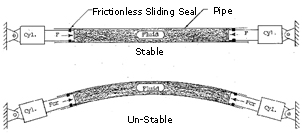
A pipe with ends sealed, but not restrained is filled with fluid and subjected to internal fluid pressure by means of a hydraulic cylinder and piston at each end. At a certain critical compressive force “Fcr” and corresponding internal fluid pressure “Pcr” the pipe will buckle. Guides are required, therefore, to prevent such buckling.
In the above situation, the pressurized column of fluid is inherently unstable and depends on the flexural rigidity of the pipe for its stability.
Let E = Modulus of elasticity of pipe: psi
I = Moment of inertia of pipe: in 4
L = Length of pipe between guides: in.
Ae = Bellows effective thrust area: in 2
Substituting into Euler’s column formula for a pivot ended column:
Fcr = 
But, Fcr = Pcr Ae
Therefore, critical buckling pressure 
A mathematical treatise of this subject and additional explanation is contained in “Reference ‘PA’ Load.”
Need another set of eyes on your project’s math? Get in contact with our engineer for guidance.